































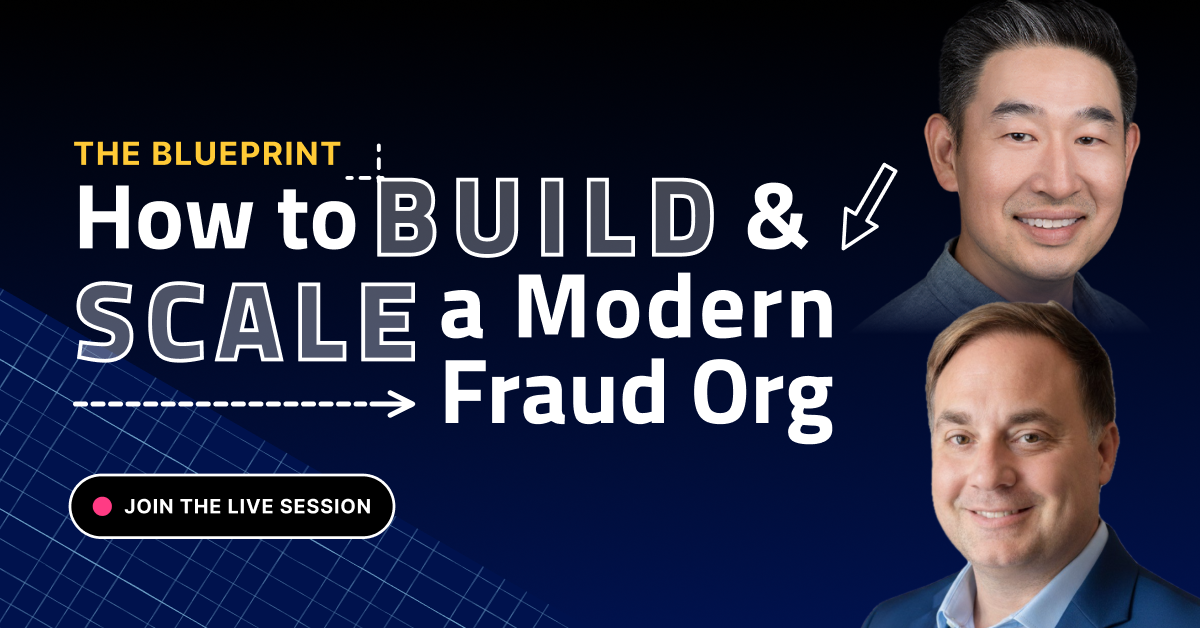
That challenge sat at the center of Sift’s Blueprint session, How to Build and Scale a Modern Fraud Organization, featuring Kevin Lee, Sift’s Field Chief Technology Officer, in conversation with Jerry Hoff, Founder and CEO of AppSec Training.
The discussion focused on a question nearly every digital business is facing: how do you scale fraud prevention without slowing growth? As fraud becomes more tightly tied to revenue, customer experience, and operational efficiency, the answer requires more than blocking bad actors. It requires better org design, stronger alignment, and trust embedded into the business from the start.
Below are the biggest takeaways from the conversation.
Fraud is much bigger than a payment problem
Fraud is not a single issue. It’s an ecosystem that spans external threats, internal tooling, disconnected teams, and abuse vectors far beyond card fraud. That matters because many organizations still approach fraud as a payments problem first. But fraud can surface at signup, login, content creation, account changes, stored value access, payouts, reviews, and other points across the user journey.
Fraud teams sit in the middle of that complexity. As Kevin put it, “You’re the connective tissue.” Attackers look for gaps between systems, teams, and controls, then exploit the weakest point. That’s why account takeover, account abuse, and payment fraud all need to be viewed together.
Account takeover and account abuse create tangible business risk
The session pushed beyond the idea that fraud is only about stolen cards and chargebacks. Many digital businesses have user accounts with value attached to them, even when that value is not tied directly to a credit card.
Loyalty points, airline miles, credits, offers, and wallets can all be monetized after an account takeover. And even when the financial loss is absorbed by the business, the damage does not stop there. Teams often also inherit support costs, remediation work, account recovery, and the reputational hit of a customer feeling unprotected.
Account and content abuse creates similar pressure. Manipulated reviews, phishing, spam, and other abusive behaviors can erode platform integrity and damage trust for legitimate users. For businesses built on user interaction or marketplace confidence, these are core business issues, not side problems.
The modern fraud blueprint starts with balancing growth and security
The blueprint centered on four core principles: balance growth with security, align cross-functionally, take a holistic view of customer behavior, and think ahead instead of staying reactive.
The first point is foundational. Fraud teams still need to reduce losses, but that conversation cannot stop there. To earn executive buy-in, fraud leaders need to connect their work to the metrics the broader business cares about, especially acceptance rate and conversion rate.
As Kevin put it: “It may not be chargebacks. It’s going to be more so around growth-oriented items, so things like acceptance rate, conversion rate.”
That mindset shift matters. A strong fraud program is not just about stopping bad actors. It is also about enabling more legitimate users to move forward with confidence. In practice, that means reducing unnecessary friction, improving decision accuracy, and avoiding overly blunt controls.
“The reason we were able to be successful from a risk standpoint is not because we said no to a bunch of people, it’s that we actually were able to say yes to a bunch of people.”
Silos are one of the biggest reasons fraud programs stall
Disconnected teams and disconnected tools create inefficiency that fraudsters can exploit. When data does not flow between systems and teams do not share goals or incentives, fraud has more room to spread.
This is where many organizations get stuck. Fraud may be looking at one set of metrics, product at another, support at another, and payments at another. The result is slower decisions, incomplete context, and more operational drag.
That’s why cross-functional alignment is a core part of the blueprint. If fraud, marketing, product, operations, and other teams are measured differently, it becomes much harder to show impact or scale effectively.
The best signals are not always the most obvious ones
One of the most useful takeaways from the session was the reminder to look beyond the transaction and consider the full customer relationship. A good example is newsletter engagement. In one case, whether a user subscribed to and engaged with the company newsletter turned out to be a strong signal of legitimacy.
“If they actually opened up the marketing newsletter and engaged with it, that was a very positive signal.”
The larger lesson is that valuable fraud signals can come from parts of the business not typically viewed as fraud infrastructure. Marketing engagement, product behavior, and account history can all provide useful context when evaluating trust.
Mature teams move from firefighting to acting closer to time zero
Fraud maturity was framed as a progression from reactive firefighting to maintaining, optimizing, and eventually innovating. That shift matters because lagging indicators like chargebacks often tell teams what happened too late to prevent damage.
The goal is to build systems and processes that let teams act closer to “time zero,” whether that is at account creation, deposit, or another critical moment earlier in the user journey.
The closer a team can get to that decision point, the better positioned they are to prevent downstream loss, reduce manual cleanup, and improve the experience for legitimate users.
Better teams connect platforms, measure the right things, and build feedback loops
What separates stronger teams from weaker ones often comes down to three things: connected platforms, meaningful metrics, and strong feedback loops across policy, training, and quality.
It’s not enough to document processes. Teams need systems that actually talk to each other, a regular pulse on the metrics that matter, and feedback loops that improve decisions over time.
That includes classic fraud metrics, but it should not stop there. Strong teams also track how fraud decisions affect approval rates, false positives, manual review, support burden, and customer experience.
Fraud leaders need to speak in business terms
Looking only at fraud loss creates too narrow a view of performance. A more useful approach is to think in terms of a total fraud budget that includes headcount, tools, and losses together.
That opens the door to better tradeoff discussions. In some cases, allowing slightly more loss may make sense if it improves acceptance rate and supports growth. It also makes it easier to show ROI in terms finance leaders care about.
The strongest fraud teams do not just prove that they can block fraud. They prove that they can help the business make better decisions about risk, investment, and growth.
Building a fraud organization for scale
The biggest message from the session was simple: modern fraud teams cannot win by focusing on losses alone. They need connected systems, aligned teams, broader signals, faster decisioning, and a clear way to show how fraud prevention protects both revenue and customer experience.
When fraud programs are dialed in correctly, they can become a competitive advantage. That’s the real blueprint. Not just stopping fraud, but building an organization that can scale with the business.
Check out more from The Blueprint webinar series.