


A fraud attack doesn’t announce itself. It starts quietly. A batch of stolen cards gets tested with small charges. A wave of fake accounts appears overnight. Chargebacks creep up over a weekend when nobody’s watching. And now that attackers use AI to run all of this at scale, it can all happen at once, in massive volume.
By the time someone notices, the fire’s already burning.
Most fraud tooling was built for a different job. It’s very good at the everyday work of deciding whether this transaction, this login, or this account is trustworthy, and Sift’s decision engine handles that work. Coordinated attacks are a different problem. They’re fast, they’re organized, and they consume analyst time. Too many teams meet them with dashboards checked by hand, exports to a Business Intelligence tool, or a colleague who happens to spot a number that looks off.
Attacks need a first responder, not a dashboard someone has to remember to check. Your team shouldn’t be the last to know. We built something to be the first.
Introducing the Sift Fraud Attack Defense Suite
The Sift Fraud Attack Defense Suite is our vision for how fraud management works when AI is applied to how practitioners actually do their jobs, not sprinkled on top as a label. It’s a centralized platform for defending against attacks across a growing set of fraud vectors, built around one arc: tell me something’s wrong, tell me what’s wrong, and tell me what to do about it.
The suite has three components, one for each stage of an attack:
- Attack Detection Agent watches your traffic around the clock and speaks up the moment something’s wrong.
- Attack Investigation Agent helps you understand what’s happening, who’s involved, and what they have in common.
- Attack Response Agent turns what was detected and investigated into action.
The suite is live now. Every stage of the lifecycle is available to your team today at a foundational level, and each one gets progressively more automated from here.
What you can do today
Detect. Attack Detection Agent is generally available and included in the core Sift platform. It runs continuously against the event data you already send to Sift, so there’s nothing new to install, no new fields to send, and no integration work. Detection learns what normal looks like for your business, including time-of-day and day-of-week patterns, so a busy Monday morning isn’t mistaken for an attack. It ships with five pre-configured alerts, live from day one:
- BIN transaction velocity
- BIN user velocity
- Chargebacks
- Low-value transaction surges
- Registration velocity
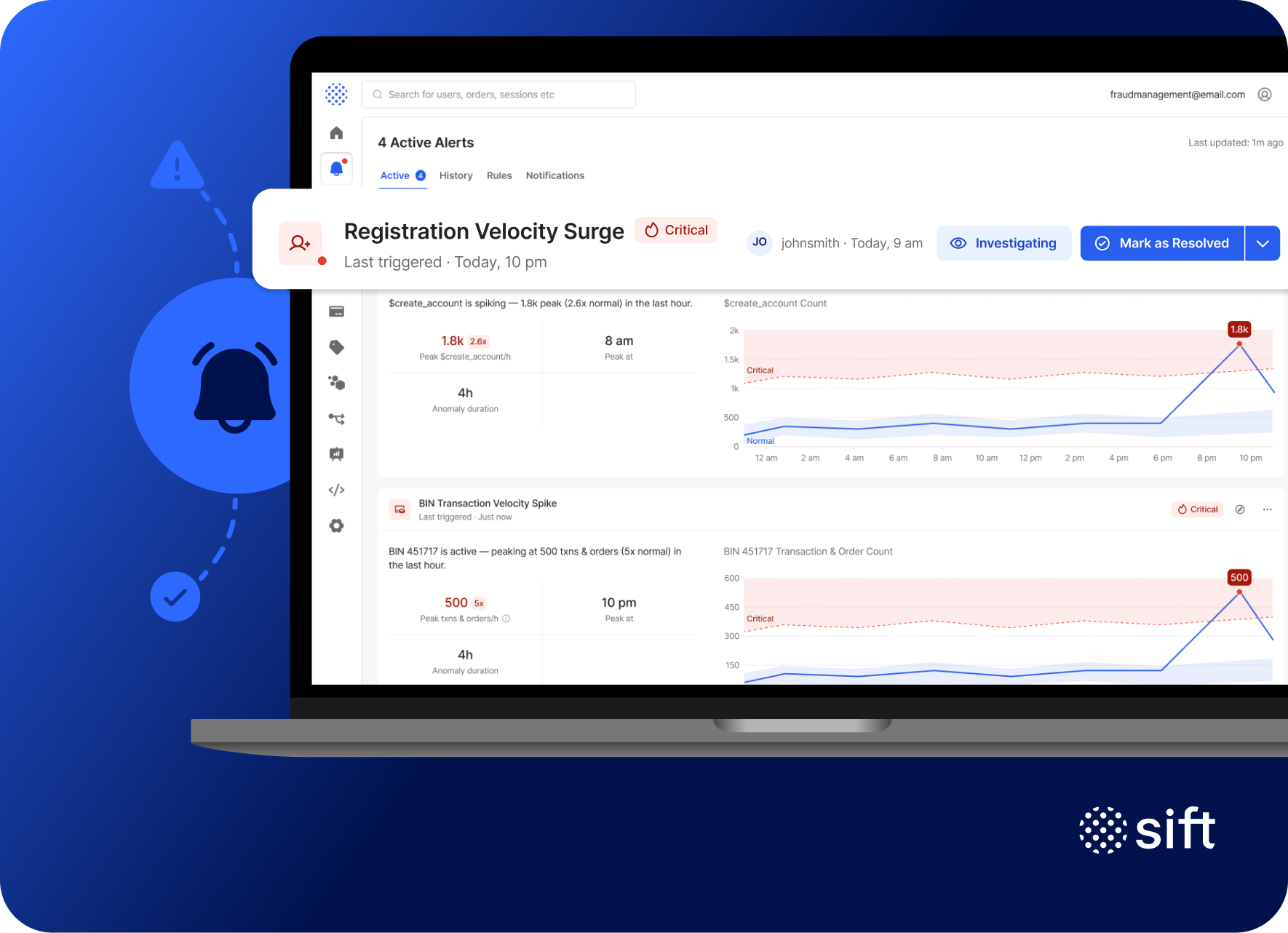
Alerts arrive in the Console, and critical alerts can also go to email. You can tune the sensitivity of each one and preview how a setting would’ve performed against your own traffic. Related detections group into a single alert, so a coordinated attack doesn’t flood your queue.
Early results show why this matters. In its first month, Attack Detection Agent caught a multi-hour, 20x transaction spike at one of our travel customers and a 13-hour card-testing surge at a retail customer. Both attacks would’ve run their full course the old way. For teams that used to find out from a downstream number, catching an attack while it’s still underway changes what it costs.
Investigate. From any alert, one click opens the events behind it: the accounts, transactions, and attributes that tie them together. Your analysts start with a picture of the attack instead of a number that changed.
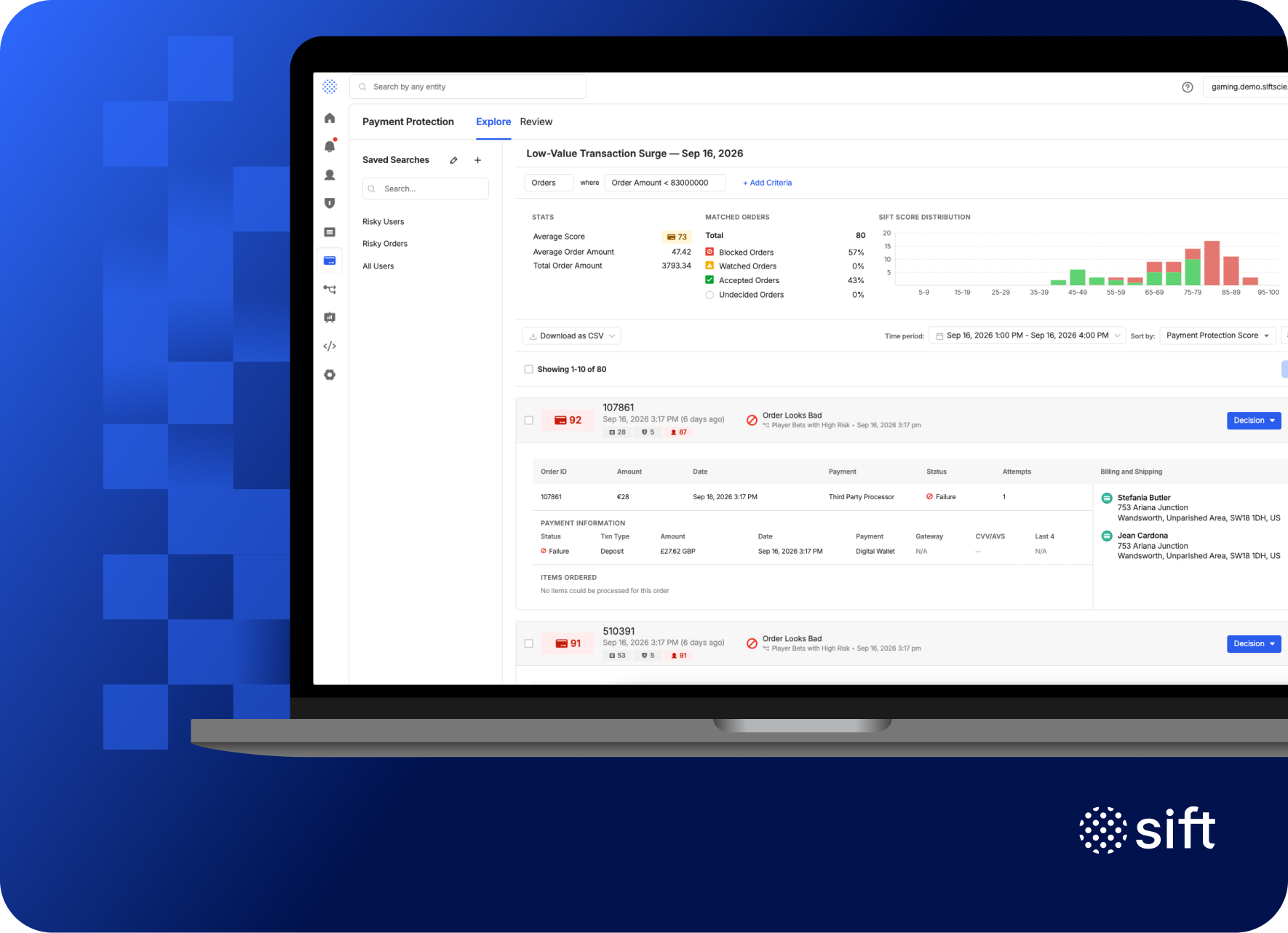
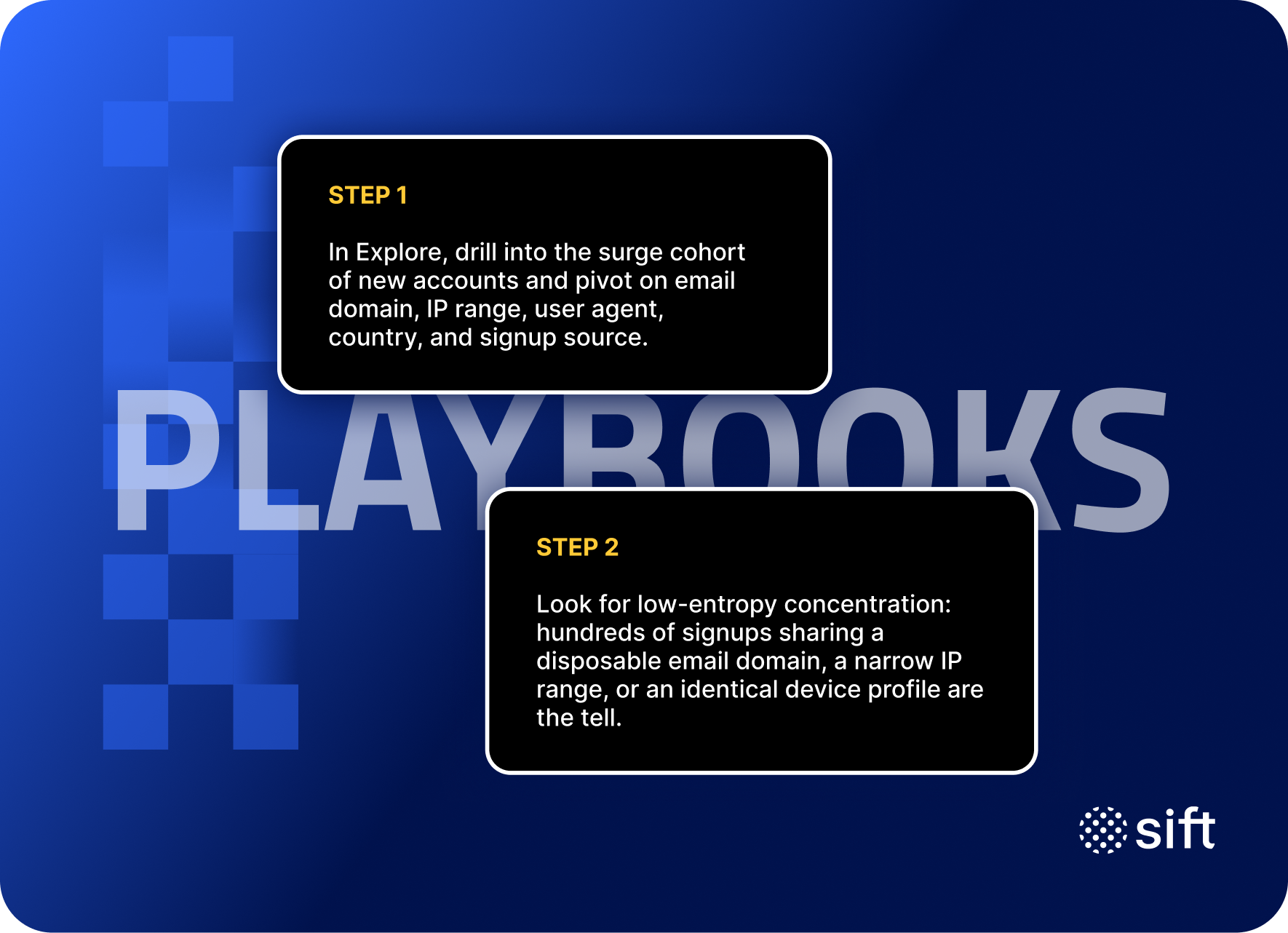
Respond. Every alert pairs with a playbook of investigation steps and recommended actions, so no one starts from a blank page. A person moves each alert through a clear lifecycle, from open to acknowledged to resolved or marked a false positive. Every alert stays in a searchable history for audit and post-incident review.
I’ll be straightforward about how it works. Detection today runs on statistical methods, not generative AI, and we won’t dress it up as something else. What makes it an agent is that it does the work for you. It monitors continuously, measures against your normal, and speaks up without anyone asking or logged in.
Built on the Sift Global Data Network
Every fraud team has to decide what normal looks like, and most have to work it out alone. The suite is built on the Sift Global Data Network, which learns from activity across merchants and industries and informs Sift’s decision engine. The starter alerts ship with defaults informed by industry benchmarks, so they’re useful on day one. From there, Attack Detection Agent measures your traffic against your own history, because a threshold built from someone else’s traffic wouldn’t fit your business. You get the breadth of a network and the precision of a baseline that’s yours alone.
Where the suite goes from here
Investigation Agent and Response Agent build on the foundation you can use today. They add reasoning, recommendation, and automation, so your analysts start with an investigation already underway and can choose to have responses put in place for the attack patterns they trust. This is what we mean when we say there’s nothing artificial about trust. Trusted commerce depends on real, practical intelligence working alongside the people who protect it. Attackers move fast. Your defense should already be there.
Ready to see it in action? Request a demo.